“You are your brother and your sister’s keeper.”
Santonio Cathery spent his childhood navigating a two-hour-each-direction daily commute, relying on two trains and two buses each way.
Growing up in Chicago’s Englewood neighborhood, an area disrupted by gang violence tied to the drug trade, Santonio’s mother, a kindergarten teacher, used his aunt’s address to let Santonio and his siblings attend a safer elementary school on the city’s North Side.
The contrast between the two neighborhoods was stark. While traveling, Santonio frequently saw crime scene tape and shell casings and witnessed the same individuals selling drugs on the corners every morning. “I just knew that just that life wasn’t for me,” Santonio said. “I knew that there was something more out there and I knew that I was meant for more than those circumstances”.
Family was a cornerstone for Santonio, who is one of six children. His mother instilled a deep respect for education, while his family’s tight-knit bond shaped his worldview. “My family’s motto is that you don’t have friends, you have acquaintances or associates, but your family are your friends,” he said. As he grew older, he naturally stepped into a protective role, taking his younger brother to school every day. “Another thing in my immediate family is that you are your brother’s and sister’s keeper,” he added.
Santonio was always a good student. His favorite subject was math. His dedication to academics caught the eye of a mentor, who introduced him to the Hope Ignites Chicago residential program and to Loyola Academy, a Catholic private school. At the time, he was torn between Loyola and a sports powerhouse closer to home, St. Rita. His mother left the ultimate choice to him. He recognized the long-term doors the program would open. “For me, it wasn’t an option of going to Loyola without Hope Ignites,” he explains. “It was the Hope Ignites and Loyola or nothing”.

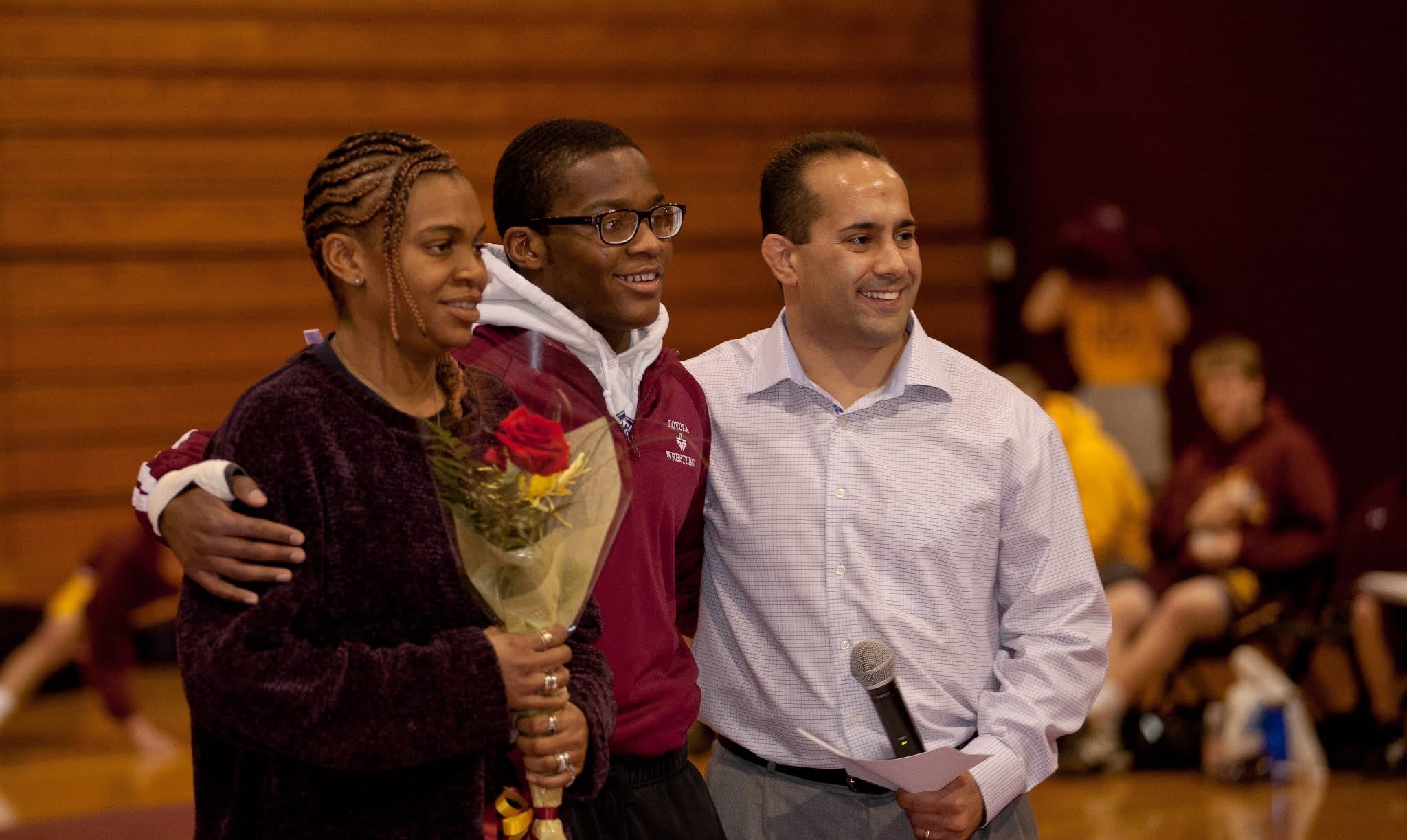
Santonio (center) with two team mates.
Moving into the Chicago residential house deeply shaped his adolescence. After sharing a single bedroom with four siblings, sometimes rationing food, and frequently boiling water on the stove for baths, the program provided an entirely new world. “It was like finding that golden ticket to the chocolate factory,” Santonio said. “I get hot water; I get a great house… I have tutors, I have structure”. As someone who naturally craved routine, he quickly thrived. He also found a deep sense of brotherhood with fellow scholars and a core group of athletic best friends who shared his background in football and wrestling, making his transition much smoother.
Attending Loyola Academy exposed him to extreme wealth, with classmates whose parents were famous athletes and CEOs. While rubbing shoulders with “true one percenters” was a culture shock, Santonio stayed grounded through his passion for football and wrestling. Having started wrestling at age five, he credits the sport with instilling relentless discipline. “It takes a lot of sacrifice, man,” Santonio saidof the grueling weight cuts and year-round training that often forced him to miss holidays. Yet, these sports provided a built-in community and a tight routine that kept him focused. Balancing academics and athletics was crucial because, as his mentor taught him, he needed to see the “big picture” to set himself up for life.
Santonio went on to attend the University of Wisconsin on a full ride, balancing rigorous academics with Division 1 wrestling. His discipline culminated in a remarkable achievement: competing at the 2012 Olympic Trials in Madison. With his family cheering him on, he came just one match away from making the US team. Academically, he thrived just as much, securing a job as a commercial banker at BMO, the US subsidiary of Bank of Montreal, before his senior year even began.
Santonio at a wrestling tournament.
“I just knew that just that life wasn’t for me. I knew that there was something more out there and I knew that I was meant for more than those circumstances.”
However, reading the book Rich Dad Poor Dad shortly after graduation shifted his professional goals. He saved his bonuses, read books and watched every YouTube video on the subject, learned everything he could about real estate, and bought his first duplex in 2020. Realizing he needed industry experience, he took an asset manager position at a private equity firm. “I looked at it like getting my MBA in real estate investing,” he said.
Now 32, Santonio recently stepped away from a corporate job at KeyBank to run his own housing business full-time. His entrepreneurial success and unwavering dedication to his community recently earned him the Legacy of Hope award at the 2026 Hope Ignites Excellence Awards. He continues to live out his family’s values by mentoring his younger brothers who followed his footsteps into the Hope Ignites Chicago residential program, reminding them that the “structure of success is in the routine.”
For young scholars navigating their own journeys, Santonio offers practical advice. “Just say yes,” he urges, encouraging students to embrace every opportunity the program provides. Above all, he emphasizes the power of persistence and showing up every day. “Trust the process,” Santonio advises. “Hard work beats talent when talent doesn’t work hard.”

Back in the competitive wrestling days.